
What do you actually need to bring to a Budapest thermal bath?
Every guide lists the same four things: swimsuit, towel, flip-flops, a padlock. That much is correct. What those lists skip is which of those four gets enforced by staff, which gets you turned away from a lane, and which gets replaced with a rental version that does not work as well as the one you left at home.
The gap between “recommended” and “actually checked at the door” is where a visit goes wrong. This article covers that gap, item by item.
Why do flip-flops matter more than they look like they should?
Because the decks are wet stone, and Budapest’s thermal baths are old buildings with slip-injury liability that predates modern tourism. Flip-flops are not a comfort item. They are close to a rule.
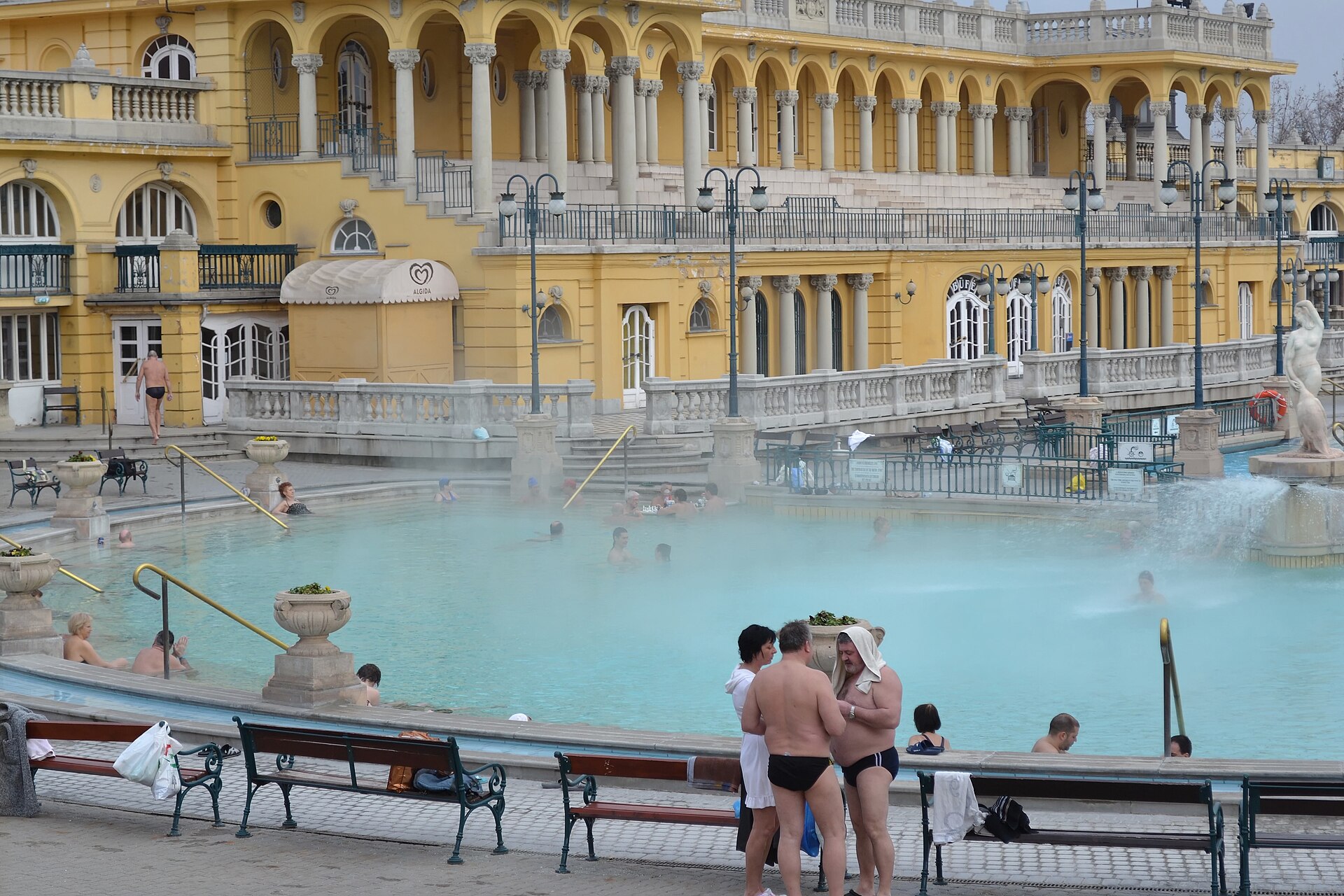
Bare feet on a soaked marble or tile surface, in a building built over a century ago, are a fall waiting to happen. Bath staff know this. At several of the larger complexes, attendants have been known to stop barefoot visitors near the pool edge and point them toward the on-site shop.
That shop sells flip-flops. At a markup. It exists precisely for the visitor who assumed sandals were optional.
The fix costs nothing: pack a pair that has already been in a pool. Rubber, not leather. Anything that dries fast and grips wet stone.
Why does a padlock from home beat a rental one?
Rental locks exist at most locker halls. They also spend all day in a humid, chlorinated room. Springs corrode. Mechanisms swell. A lock that clicked shut an hour ago can refuse to open.
When that happens, the fix is not fast. Staff have to locate a supervisor, confirm the locker assignment, and cut the lock manually. That can mean a wait — sometimes a long one — while a visitor stands in a towel, holding a bath ticket, wanting their clothes back.
A padlock brought from home has usually spent its life in a dry drawer. It is far less likely to jam. It also means no queue at the rental counter on the way in, which matters more on a Saturday than a Tuesday — a pattern this site covers in more depth in why a Budapest bath costs more on Saturday than Tuesday.
Bring a small, cheap combination lock. It is the single most useful item on this whole list.

What is the swim cap rule at the lap pool, and who enforces it?
Most Budapest baths separate the recreational thermal pools from a dedicated lap or swimming pool, and the lap pool runs under different rules. A cap requirement is common there, tied to filtration and hygiene standards rather than fashion.
Lane attendants enforce it. Not a sign — a person, standing at the end of the lane, who will ask a swimmer to leave the water and buy or rent a cap before returning.
This catches visitors who packed for the thermal pools — where caps are not required — and never thought about the separate lap circuit at all. It is a five-minute detour, not a disaster. But it is a detour every single lap swimmer without a cap will make, one at a time, at the edge of the lane.
Caps are sold or rented on site at most baths. The current fee, and whether silicone or fabric caps are accepted, is set by the operator and published on its own site — worth a check before travel rather than an assumption at the turnstile.
The three assumptions that cost visitors time or money
None of these three items appear as a hard requirement on every ticket. All three get enforced in practice, at the point where it is least convenient to fix.
| Item assumed skippable | Why visitors skip it | What actually happens on site |
|---|---|---|
| Flip-flops | “I’ll just be barefoot, it’s a spa” | Staff can stop barefoot visitors near wet decks; on-site sandals are sold at a markup |
| Own padlock | “The locker room will have rentals” | Rental locks jam from daily humidity exposure; a jammed lock means a staff-supervised wait to cut it off |
| Swim cap | “I’m only using the thermal pools” | Lane attendants turn back capless swimmers at the lap pool and send them to buy or rent one |
The pattern across all three is the same. Nothing stops a visitor at the entrance gate. The stop happens later, deeper into the visit, once towels are wet and clothes are already in the locker.




What else is worth packing, and what should stay in the hotel room?
Beyond the three items above, a short list covers most of what actually gets used.
- A second swimsuit, if the plan includes both an outdoor and an indoor pool session — wet swimwear under street clothes is uncomfortable for hours, not minutes.
- A refillable water bottle. Thermal water is mineral-rich and dehydrating over a long soak; most baths have drinking-water points, though not always near the pools themselves.
- A dry bag or plastic bag for wet items on the way out, since lockers are for storage, not for drying anything.
- Basic flip-flop-friendly footwear for the walk between changing area and pool, distinct from street shoes.
Valuables — passports, spare cash, a second phone — are better left at the hotel. Lockers are secure by design, but no bath guide, including this one, can make a safety claim about them. Follow your own government’s standard travel-security guidance on valuables in public facilities.
How does cabin vs. locker change what needs to be carried?
A cabin is a private changing space; a locker is a shared room with individual storage. The difference changes how much gear makes sense to bring.
With a locker, minimal packing wins: everything has to fit in one compartment, accessed in a shared, often crowded space. With a cabin, there is room to change at a slower pace, store a bag rather than a bundle, and leave a robe or extra layer without worrying about space.
Ticket structure usually reflects this: cabin access typically costs more than locker-only entry, and the tariff logic behind that gap — what a cabin buys beyond privacy — is set out in what a cabin buys you over a locker at a Budapest bath.
What about towels and bathrobes — bring one, or rent one?
Towel rental is available at most major baths, usually for a separate fee on top of entry. Bringing a full-size towel from the hotel avoids that charge and avoids a queue at the rental counter.
A large towel also does double duty: it can be used to sit on around some of the outdoor pool decks, where seating is limited and stone can be uncomfortably hot or cold depending on season.
Bathrobes are a different matter. They are a comfort rental, not a functional one, and skipping the robe rental costs nothing beyond a slightly colder walk between pools.
Does the bath sell anything a visitor forgot?
Yes, almost always. Flip-flops, caps, locks, towels, even swimwear in some cases — all of it is sold or rented on site, because forgetting one of these items is common enough to be a predictable, priced-for event.
That is also the catch. On-site rental and retail prices are set to cover convenience, not to compete with what the same item costs in a shop the day before. Bringing it yourself is nearly always cheaper.
Current rental and retail prices are published on each operator’s own site and change without much notice. Széchenyi Thermal Bath and Gellért Thermal Bath, two of the city’s best-known operators, list their own current rental terms directly — check those pages rather than a secondhand figure before travel.
How does the weekend affect what is worth bringing?
Weekend visits run busier, and busier means longer queues at every rental counter — locks, towels, caps, all of it. A padlock and a towel from home skip those queues entirely.
This is one small part of a larger pricing and demand pattern across Budapest’s baths, where weekday and weekend visits are structured, and often priced, differently. That structure is covered in full in why a Budapest bath costs more on Saturday than Tuesday.
Choosing which bath to visit at all — and which one suits a given day, schedule, or interest — is a separate question, addressed in Széchenyi or Gellért: which bath fits your day.
Where do these details come from, and how current are they?
Operating rules like cap requirements and locker systems are set by each bath’s own management and can vary between sites even within the same city. The Hungarian national tourism site, Visit Hungary, provides general orientation on the country’s bath culture, though specific rules belong to each operator.
Nothing in this article states a current price. Where a fee is mentioned — cap rental, towel rental, lock deposits — the operator’s own published price list is the only reliable source, and it should be checked close to the travel date rather than assumed from an older article.
More on how this site sources and checks what it publishes is set out in how Access Budapest is written, checked and paid for, and what the site collects from readers is covered in its privacy policy.
Access Budapest is an independent guide written from published, checkable sources. We have not visited the places described here and we do not publish personal recommendations or invented ‘local favorites’ — where something is singled out as notable, we say who says so. Opening times, fares, closures and prices change at short notice, so treat everything here as a starting point and confirm with the museum, operator or venue directly before building a day around it. We give no advice on visas, insurance, health or safety; use your own government’s official guidance for those.
Featured image: Photo by Slyronit, source, CC BY-SA 4.0
