
The mistake that actually causes trouble is narrower than most advice suggests. It is not the swimsuit, and it is rarely the towel. It is footwear on the pool deck itself, and a bare head in a marked swimming lane. Locker rooms tolerate flip-flops everywhere. The deck around a lap pool often does not, and whether that rule is enforced depends entirely on which bath, and which pool inside it, a visitor is standing beside.
What actually gets a visitor stopped or asked to leave?
Two things, specifically. First: walking onto the tiled surround of a marked swimming pool in ordinary flip-flops, rather than barefoot or in dedicated non-slip pool shoes. Second: entering a lap lane without a swimming cap. Both come from the same source — Hungarian public swimming-pool hygiene and safety practice, which draws a hard line between a thermal soaking pool and a regulated swimming pool, even inside the same building.
A thermal soaking pool is not classed the same way as a lap pool. It has no lanes, no continuous lifeguard patrol, and usually no cap requirement at all. A swimming pool with marked lanes is a different category of facility, and that is where caps and deck footwear rules actually get checked.
Which pools require a cap, and which don’t?
The cap rule tracks the pool’s function, not the bath’s brand. Lap lanes require one. Soaking pools generally do not.
- Indoor sport and lap pools — cap required, and this is the pool type most likely to have a lifeguard stationed close enough to check.
- Large outdoor thermal soaking pools — no lane markings, no cap requirement, minimal active monitoring.
- Whirlpools, wave pools, and children’s pools — no cap requirement, but often the loudest water in the building.
Széchenyi and Gellért both combine a lap-swimming hall with separate outdoor thermal pools, so the cap rule changes depending on which door a bather walks through. Széchenyi’s own posted bathing rules, published on its official site, set out where caps apply inside its complex, and readers planning a swim rather than a soak should check that page directly, since the layout runs across several buildings. Széchenyi’s official site is the source to confirm before arrival.
Where is this actually enforced by staff, and where is it just a sign?
This is the distinction that most etiquette guides skip. A posted rule and a checked rule are not the same thing, and the gap between them is where visitors get caught out.
| Rule | Where it tends to be actively checked | Where it is usually just signage |
|---|---|---|
| Swimming cap in lap lanes | Indoor sport pools with a lifeguard station at lane’s edge — the swimming halls at Széchenyi and Gellért | Outdoor thermal soaking pools without lanes |
| No street flip-flops on pool deck | The tiled surround immediately bordering a marked lap pool | Corridors between locker room and thermal deck, where compliance is largely self-policed |
| Shower before entering any pool | Turnstile-and-shower entry corridors at the larger municipal baths | Smaller historic sites with fewer staff on the floor |
The pattern is straightforward. Wherever a bath employs a lifeguard for genuine swimming safety, that same person tends to enforce the cap and footwear rule, because it is part of the same job. Wherever a pool is a soak rather than a swim, the rule is written on a wall, and nobody is specifically posted to check it.
Rudas, with its historic octagonal Ottoman-era pool built in 1566, has less of the lane-and-lifeguard structure that drives strict cap enforcement elsewhere, though it does operate a separate swimming pool with its own posted rules. Rudas’s own site lists current requirements by pool. Gellért, which opened in 1918 with a formal indoor swimming hall attached to its thermal wing, follows the same lane-versus-soak split, detailed on Gellért’s official site.

Why is a flip-flop a problem at all — isn’t that the standard advice?
It is, and the advice is not wrong. Flip-flops are the correct footwear for corridors, showers, and locker rooms, where bare feet on tile risk fungal infection. The confusion is about where they stop being appropriate.
A regulated swimming pool deck is a wet-safety zone, not a hygiene zone. Ordinary flip-flops, designed for dry pavement, slip on tile that lap swimmers are actively splashing. That is a fall risk near a pool edge, which is why lifeguards treat it as a safety issue rather than a dress-code one. The fix is simple: keep flip-flops for the corridor, go barefoot or use dedicated pool shoes on the deck itself.
A fuller rundown of what actually belongs in a bath bag — cap, lock, robe, appropriate footwear for each zone — is covered separately in what to actually bring to a Budapest thermal bath.

Are any Budapest pools actually “silent”?
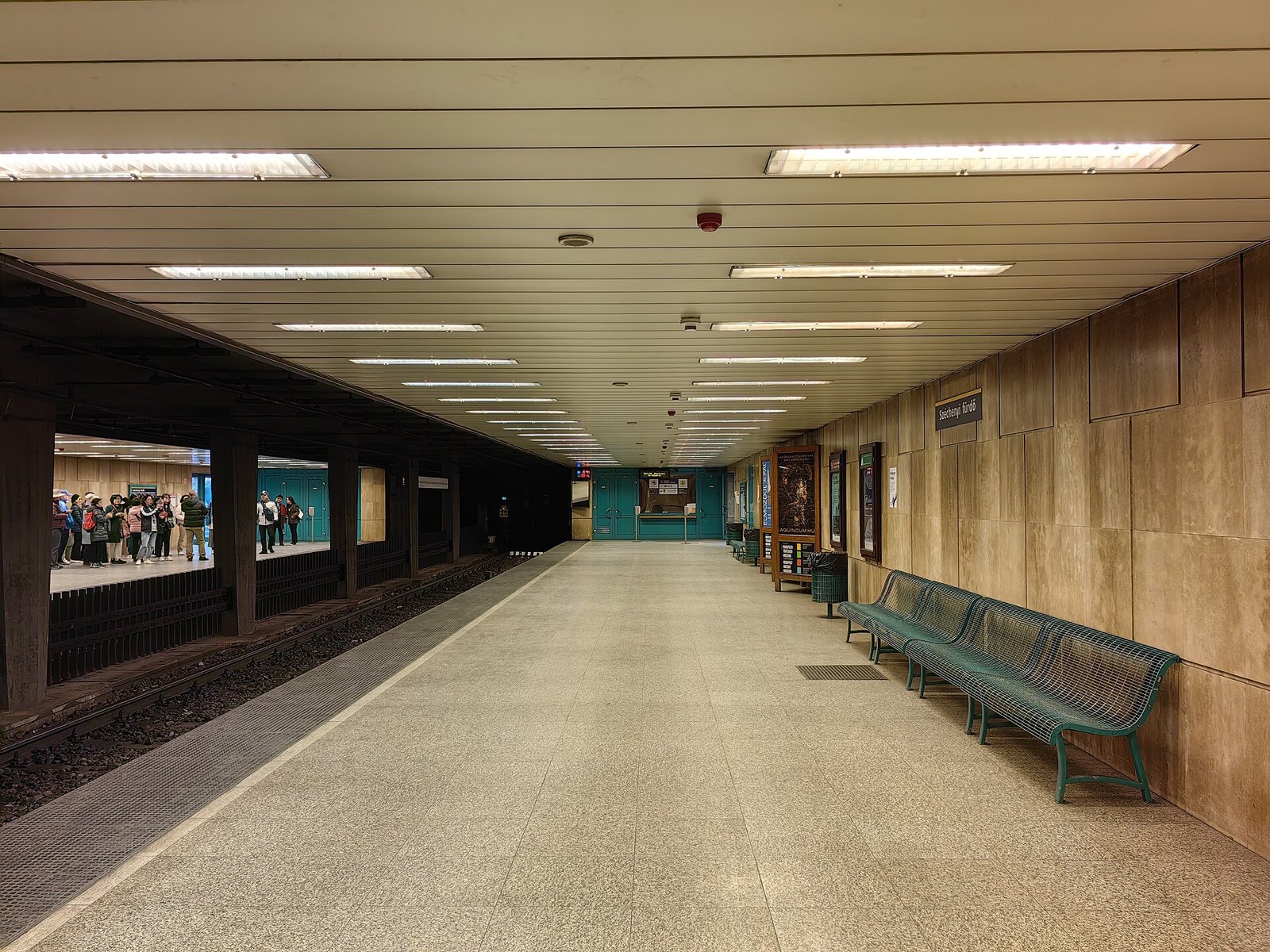
Not by formal rule, as far as public documentation shows. No Budapest bath posts an enforced silence policy the way some spas elsewhere do. What exists instead is a functional split, driven by pool type rather than any written code.
Large soaking pools, especially outdoor ones with groups and games of chess, carry conversation easily and are not quiet by design. Indoor lap pools are quieter because lifeguards are managing swimmers, not because talking is banned. Smaller, less crowded baths — Rudas, Lukács, and Veli Bej among them — tend to be calmer simply because they draw fewer visitors and have less of the large group and package-tour traffic that fills Széchenyi’s outer courtyard on a weekend.
So “silent” is really a proxy for visitor volume and pool type, not a posted house rule. A midweek morning at a smaller bath will be quieter than any bath at all on a Saturday, a pattern explained in more detail in why a Budapest bath costs more on Saturday than Tuesday.


Does a cabin or a private locker change any of this?
No. Cap and footwear rules attach to the pool, not to what a visitor rented at the entrance. A cabin buys changing privacy and a place to store belongings; it has no bearing on lap-lane or deck rules once someone is out at the water.
The practical difference between the two entry types — worth understanding before paying more for one — is set out in what a cabin buys you over a locker at a Budapest bath.
Does a massage or spa package come with different rules?
No, and this trips up some visitors who assume a paid treatment exempts them from the pool-deck rules. A booked massage is a separate service, usually in its own room, and does not change what applies once the same guest is back at the water. Whether these add-on packages are worth booking at all is a separate question, covered in are Budapest bath packages and massages worth it.


Does winter change any of the enforcement pattern?
Slightly, and mostly for practical reasons rather than new rules. Outdoor pools steam heavily in cold weather, footing near the deck edge gets more attention from staff, and indoor lap pools see more traffic as visitors shift indoors. The cap and footwear rules themselves do not change season to season; what changes is covered in visiting a Budapest thermal bath in winter: what changes.
Which bath is easiest to navigate on a first visit?
Széchenyi and Gellért are the two most visited, and structurally the most complex, since each mixes lap pools, thermal soaking pools, saunas, and steam rooms across multiple buildings. Working out in advance which zone requires a cap avoids most confusion on arrival. A direct comparison of the two, matched to what a given visitor actually wants from the day, runs in Széchenyi or Gellért: which Budapest bath fits your day.
A short checklist before walking in
- Bring flip-flops for corridors and locker rooms — not for the deck beside a marked swimming pool.
- Pack a swimming cap if any lap swimming is planned. It is often required only there.
- Shower before entering any pool. Larger baths route this through the entry corridor itself.
- Expect enforcement near lifeguard stations, and self-policing everywhere else.
- Treat “quiet” as a function of pool type and time of day, not a posted rule.
None of this is guesswork specific to one visitor’s trip. It comes from how these facilities are staffed and zoned, which is public information any bath’s own operator publishes and updates directly. How this site sources and checks that kind of detail is explained on the About page; what the site collects from a reader visiting it is set out in the privacy policy.
Access Budapest is an independent guide written from published, checkable sources. We have not visited the places described here and we do not publish personal recommendations or invented ‘local favorites’ — where something is singled out as notable, we say who says so. Opening times, fares, closures and prices change at short notice, so treat everything here as a starting point and confirm with the museum, operator or venue directly before building a day around it. We give no advice on visas, insurance, health or safety; use your own government’s official guidance for those.
Featured image: Photo by Random photos 1989, source, CC BY-SA 4.0
